
Blog Post
Scotts Monument
Standing proudly in East Princes Street Gardens, the Scott Monument is a Victorian Gothic spire
The History of the Scott Monument
Following the death of legendary Scottish novelist and poet Sir Walter Scott in 1832, a public competition was held to design a fitting memorial in his home city.
The Secret Architect: An entry was submitted under the alias “John Morvo” (a medieval architect who worked on Melrose Abbey) by George Meikle Kemp, a self-taught joiner and draftsman.
Kemp feared his lack of formal architectural training would ruin his chances, but his breathtaking Gothic design won over the judges.
Construction & Controversy: Construction began in 1841 and was plagued by financial overruns, rising costs, and local skepticism. Originally expected to cost around £5,000, the final bill soared past £16,000. It was finally completed in the summer of 1846.
The Centerpiece: Housed at the base of the spire is a massive white Carrara marble statue of Sir Walter Scott sitting alongside his beloved hound, Maida. The monument is also adorned with 68 figurative statues representing characters from Scott’s novels, as well as notable historical figures like Robert Burns and Mary, Queen of Scots.
Weird Stories and Dark Legends
Behind its dramatic black-and-gold stonework and soaring height, the Scott Monument has a history wrapped in bizarre twists, and urban myths:
- The Architect’s Fatal Fog: Tragically, George Meikle Kemp never saw his masterpiece finished.
- On a foggy night in March 1844, while walking home from visiting a contractor near the canal, he apparently lost his footing, fell into the Union Canal, and drowned.
- In a poetic twist of fate, he is buried in St. Cuthbert’s Kirkyard, directly overlooking the gardens and his monument.
- The “Gothic Rocket” Scorn: While today it is an Edinburgh icon, the monument has faced sharp criticism over the years.
- Famed author Charles Dickens notoriously loathed it, dismissing its unique silhouette by comparing it to “the spire of a Gothic church taken off and stuck in the ground.”
- The Illicit Italian Block: Transporting the massive 30-ton block of Italian marble for Scott’s central statue was an adventure of its own. It was so heavy that it crashed straight through the hull of the shipping vessel. Once it finally reached Leith docks, it took a team of 25 horses to drag the massive stone block through the streets to the sculptor’s studio.
- Masons’ Jokes in Stone:
- True to medieval stonemason traditions, the intricate carvings hidden high up in the spire include various grotesques and playful visual jests carved into the architecture, watching silently over Princes Street.
Climbing the 287 Steps
- The Narrow Staircases: The monument features narrow spiral staircases that get progressively tighter as you go up. It is definitely not recommended for anyone who is claustrophobic or struggles with tight spaces. There are four different viewing platforms at various heights up the spire.
- The Tolls: To reach the highest platform, you have to climb all 287 steps. Along the way, you pass through tiny open-air viewing balconies enclosed by intricate stone lacework, giving you a dizzying look at the ornate gargoyles and statues up close.
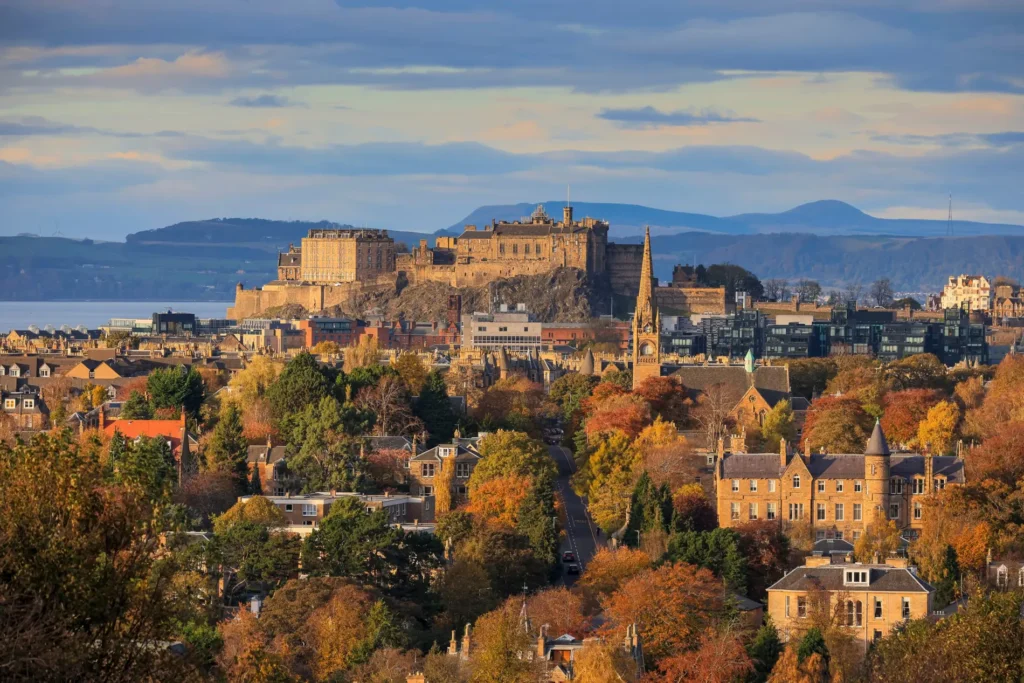
- The Breathtaking View: Reaching the top rewards you with a panoramic, bird’s-eye view of Edinburgh, looking out over Princes Street, the Old Town, Edinburgh Castle, and out toward the Firth of Forth on a clear day.
A Quick Look at Sir Walter Scott
Known as the father of the historical novel, Sir Walter Scott (1771–1832) was a massive literary rock star of the 19th century.
- Anonymous Success: He initially published his famous “Waverley Novels” anonymously because writing novels was considered a bit too frivolous for a respectable lawyer and clerk. The books were so wildly popular that everyone tried to guess the author, creating a massive literary guessing game known as the “Waverley Novels mystery.”
- Financial Ruin: Despite making a fortune from his writing, Scott went deeply into bankruptcy late in life due to the collapse of his publishing firm. Rather than declaring himself free of debt, he spent his final years working furiously to write his way out of it, successfully paying off his creditors posthumously through his book royalties.
Scott’s monument Edinburgh
